
Happy Wednesday! Below, you’ll find:
Why the model you use when talking to AI matters
FleishmanHillard on how AI is rewriting communications
How one agency head advises her team and clients on how to best use AI
Let’s get started!
THE LEDE
💡 The Two Types of Chatbots And Why It Matters

There are two types of AI chatbots: Those that use “reasoning” models and those that use “non-reasoning” models. And for now — until “reasoning” becomes cheaper and faster — which model you use can make a huge difference.
Let’s start with something a bit more fun. (Pressed for time? Scroll to the bottom of this section and I’ll give you a quick summary.)
🚗 The Car Wash Test
This has been going around social media lately. You ask ChatGPT and other LLMs a simple question — “There's a car wash about a quarter mile for my house. Should I walk or drive there?” — and laugh at the replies. It’s a car wash — if you’re not taking your car there, you’re not going to get it washed. Unless you’re Walter White, why else would you go to a car wash?
Unfortunately, many LLMs — large language models — don’t get that. Here’s a screenshot from a ChatGPT conversation, if you want proof. I asked if I should walk or drive — and it focuses on the weather. Here’s the response I received (larger version here):

This happens because ChatGPT’s current default model, 5.2, is designed to respond quickly, not thoughtfully — at least, at first. It’s not reasoning through the logic — it’s generating the most statistically likely next words based on patterns it learned during training. This is the reasoning versus non-reasoning distinction in action.
Non-reasoning LLMs work quickly. They generate responses by predicting the most likely next word (technically: next “token”) based on patterns they learned during training.
👍 They’re good at summarizing text, rewriting content, and answering straightforward questions — like whether you should walk or drive to a nearby business.
👎 But internally, they don’t explicitly break problems into steps or “think through” the logic, and often confidently give silly if not wrong answers to more complex questions.
Reasoning LLMs are deliberative and explicitly break problems into steps internally. They’re structured to handle multi-step thinking more reliably. They’re trained to apply internal reasoning before answering.
👍 They’re better at solving problems and act with a bit of cynicism, handling ambiguity by asking for clarification.
👎 But this “thinking” takes more computer power, so they’re slower and more expensive to use. You might not be paying the LLM bill, but someone at your company is.
ChatGPT 5.2 is a hybrid model — it detects whether it can give you a non-reasoning response first (saving time and money), and if not, digs deeper. In this case, it thought that I was asking a simple question and defaults to a non-reasoning response. And it failed.
If you have a paid ChatGPT account, you can actually tell the bot to use the 5.2 Thinking model — the Reasoning LLM — and you may get the right answer. Here’s what 5.2 Thinking gave me (larger version here):

The “Thinking” model still talks about the weather — nobody’s perfect! — but it ultimately gets the point, saying that “if you’re going to wash your car, you’ll obviously need the car there—so you’d drive.”
💡 What This Means for Communicators
Simply put: you need to use the right tool for the right job.
Ask yourself:
Is this primarily a language task? Use non-reasoning. It’s faster and cheaper.
Is this about decision making? Use reasoning — you don’t want your stakeholder to be at the car wash without their car.
Here’s an infographic NotebookLM put together for me — click here for a larger version.
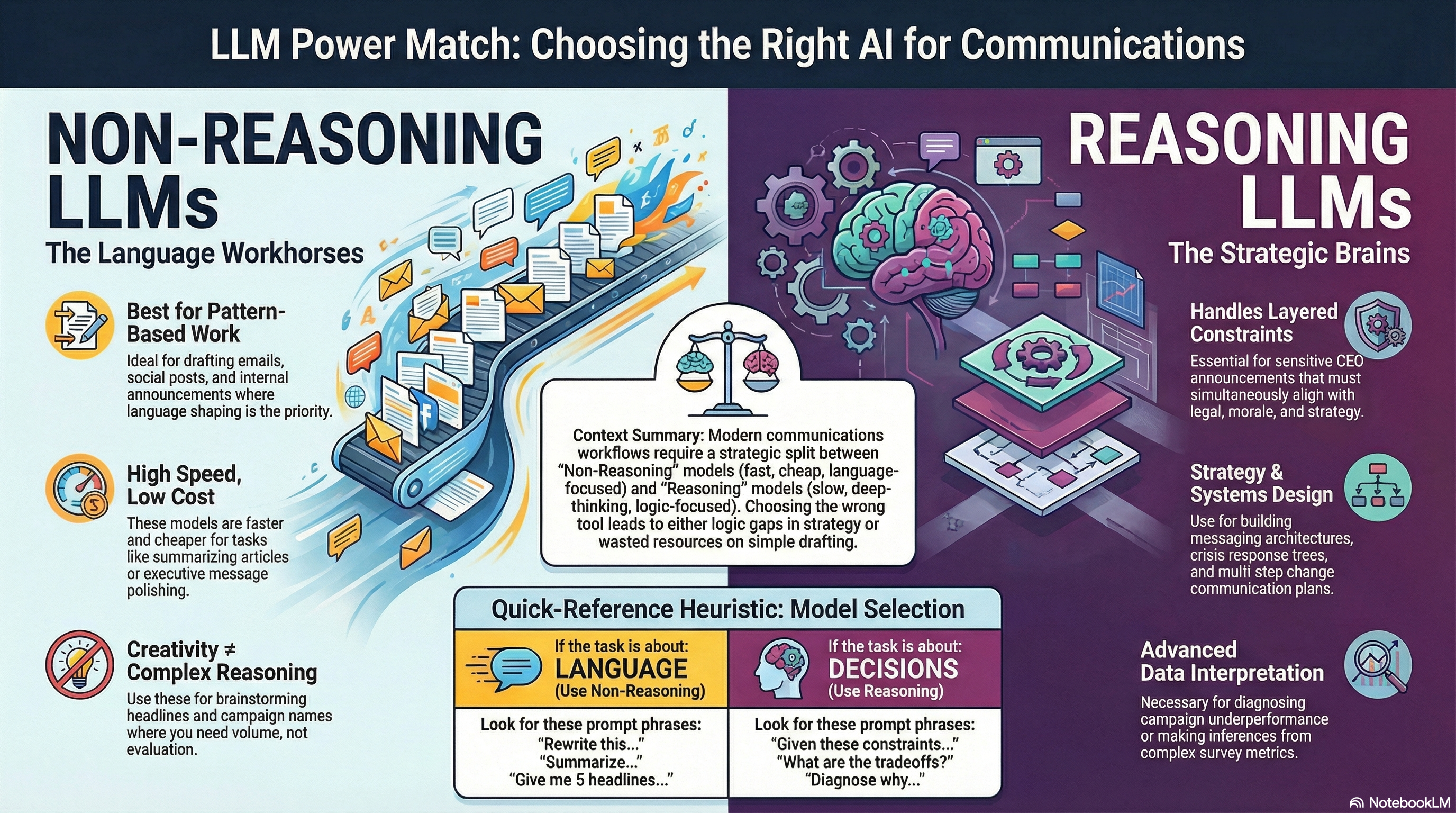
“But wait — comms work is about both language and decision making!” Yep, you’re right, and that’s OK. To account for this, switch between models as needed, drafting with a non-reasoning model and then turning on the reasoning model to pressure test, etc.
Draft with non-reasoning
Switch to reasoning, and pressure test
Rinse, repeat
And yes, that last bullet was a car wash joke.
SPONSORED BY
📈 Business News at the Speed of You
The decision is yours

Confusing, jargon-packed, and time-consuming. Or quick, direct, and actually enjoyable.
Easy choice.
There’s a reason over 4 million professionals read Morning Brew instead of traditional business media. The facts hit harder, it’s built to be skimmed, and for once, business news is something you actually look forward to reading.
Try Morning Brew’s newsletter for free and realize just how good business news can be.
THIS WEEK IN AI
🌎 Why AI is a “Learn By Doing” Discipline
Last week, FleishmanHillard’s Ephraim Cohen spoke to Forbes about how AI is transforming comms work. His key piece of advice is to get your hands dirty:
Cohen’s point is that expertise comes from time spent doing the real work, learning by practice rather than theory. Because generative AI is still so new, he argues that everyone, including seasoned professionals, needs to re-engage with the basics and build hands-on capability. That means developing strong prompting, learning how to build AI agents, creating several of them, and then connecting them into a broader agentic solution that can deliver meaningful outcomes.
You can watch his 57-minute talk with Forbes’ Bernard Marr below:
Some other key takeaways:
Build capabilities, not just prompts: Yes, you need to experiment, but that’s not enough. Communications teams need structured capability-building — shared frameworks, internal training, and repeatable workflows — so AI becomes embedded in how teams actually operate.
It’s people plus AI, not either/or: Cohen emphasizes that AI isn’t about replacing communicators — it’s about augmenting them. The professionals who thrive will be the ones who combine strategic judgment, creativity, and ethics with AI’s speed and scale.
Governance is a competitive edge — Responsible use isn’t a compliance afterthought; it’s part of the value proposition. Clear guardrails around data privacy, bias, and quality control help build client trust — and differentiate teams that take AI seriously from those that just dabble.
🎯 Quick Hits
“AI Doesn’t Reduce Work—It Intensifies It.” That’s the headline from the Harvard Business Review, citing a study that found that “employees worked at a faster pace, took on a broader scope of tasks, and extended work into more hours of the day, often without being asked to do so.”
AI search and GEO (generative engine optimization) remain in the news. Adweek asserts that “AI-mediated answers are increasingly replacing search-driven discovery” with “more value accruing to being the source the model cites, not the page that ranks third.”
Similarly, PRNewswire warns that communicators need to “treat GEO as essential instead of optional,” tracking results across multiple chatbots, measuring both qualitative results (“do we show up accurately”) as well as quantitatively.
COMMUNITY CONVERSATIONS
✍ “I Would Never Tell My Client Not to Try”
I connected with Rachel Petersen of Nectar Communications, to better understand how her team — and her clients — were using AI. She talks about being curious, embracing new tools, and experimenting — but being careful to establish guardrails and not take the human out of the loop.
Across your client base, where are you seeing AI actually show up in communications work today — not just as experimentation, but in real deliverables?
Beyond the common uses, like meeting notes and follow ups, we’re seeing the greatest value in the more complex insights and data from AI Visibility/GEO (I don’t ever want to see an impressions # again!). The power to see how AI platforms perceive and present your brand, then influence the sources they rely on, is an incredible growth accelerator. Also, using AI for initial quick media analysis and coverage reports is the #1 right now.
How have client expectations changed because they assume AI makes communications faster or cheaper, and how do you reset those expectations when needed?
Client expectations continue to rise — and rightfully demand excellence. Everything we produce should be quality, smart, compelling work that accurately reflects the company's brand and point of view while delivering results. This hasn't changed.
When it comes to AI use, transparency is essential. We added clauses to our standard contracts indicating that Nectar uses AI. Clients can request removal of this clause if they prefer we don't, but so far none have.
Where does AI create the most leverage inside an agency environment specifically, and where does it create more risk than value?
We’re enjoying the increase in productivity - the ability to put time towards more meaningful, results-driven work. By spending much less time on administrative tasks and setting things up (we love our GPTs and Gems), we get to spend time on the most important and effective results-focused activities. And, of course, we’re leveraging the new data available to us via GEO.
On the risk side, I do worry about a sea of sameness — an over-reliance on ease and speed that leads not just to AI slop work, but to AI slop personalities. I work to combat this fear by actively challenging the AI and questioning outputs, pushing the Nectarines to stay sharp, have those face-to-face meetings and ensuring our work remains current and distinctly our own. We never put forth just a rinse-and-repeat idea.
If a client asked you tomorrow, “What should we absolutely not be using AI for yet?” what would you tell them — and why?
I think we should all be leaning into AI and understanding it as much as we can - how it will help us in our jobs, what we like about it and what we don’t. I would never tell my client not to try.
My counsel: Let AI take the busy work off your plate and spend that recaptured time on something more valuable. Experiment a little, get your company’s AI approach documented and agreed on so that you know the guardrails, and make sure there's a real human hand in everything the brand puts out right now.
Want to share how your team is using AI? Reply to this email let’s talk!
SPONSORED BY
🖱 Dive into ChatGPT with HubSpot
Want to get the most out of ChatGPT?

ChatGPT is a superpower if you know how to use it correctly.
Discover how HubSpot's guide to AI can elevate both your productivity and creativity to get more things done.
Learn to automate tasks, enhance decision-making, and foster innovation with the power of AI.
COOL AI TOOLS
🔨 Five Tools To Try This Week
Rehumanize - Makes AI-written content sound genuinely human and natural
Generative Pulse - PR-focused insights into how AI describes brands
PlusAI - Generate presentations in PowerPoint or Google Slides
Guru - AI-enabled internal knowledge base connected to comms workflows
PostSyncer - Cross-platform content scheduling and social distribution
And don’t forget MESSAGE — my custom GPT that works with you to create a great first draft for just about any comm. (Learn more about MESSAGE here.)
Was this forwarded to you by a friend or colleague? Want to get this in your inbox next week? Click here to subscribe!
YOUR FEEDBACK WANTED
🔊 Help The Comms Stack Improve
What did you think of this week's email?
Until next Wednesday,
Dan