
Happy Wednesday! Below, you’ll find:
600+ AI prompts for virtually any comms scenario
Gartner’s predictions for changes in comms over the next three years (hint: more AI)
Why AI may be creating your next big headache
A free webinar this week: vibe coding for comms pros
Let’s get started!
THE LEDE
💡 A Free, Practical Comms Prompt Playbook
For the past few weeks, I’ve been exploring how communicators can actually use AI — not as a shortcut, but as a thinking partner. I’ve shared frameworks, experiments, and even a custom GPT to walk through strategy step by step. But a lot of that can be overwhelming. So I built something concrete: a structured prompt playbook designed specifically for how communicators actually work.
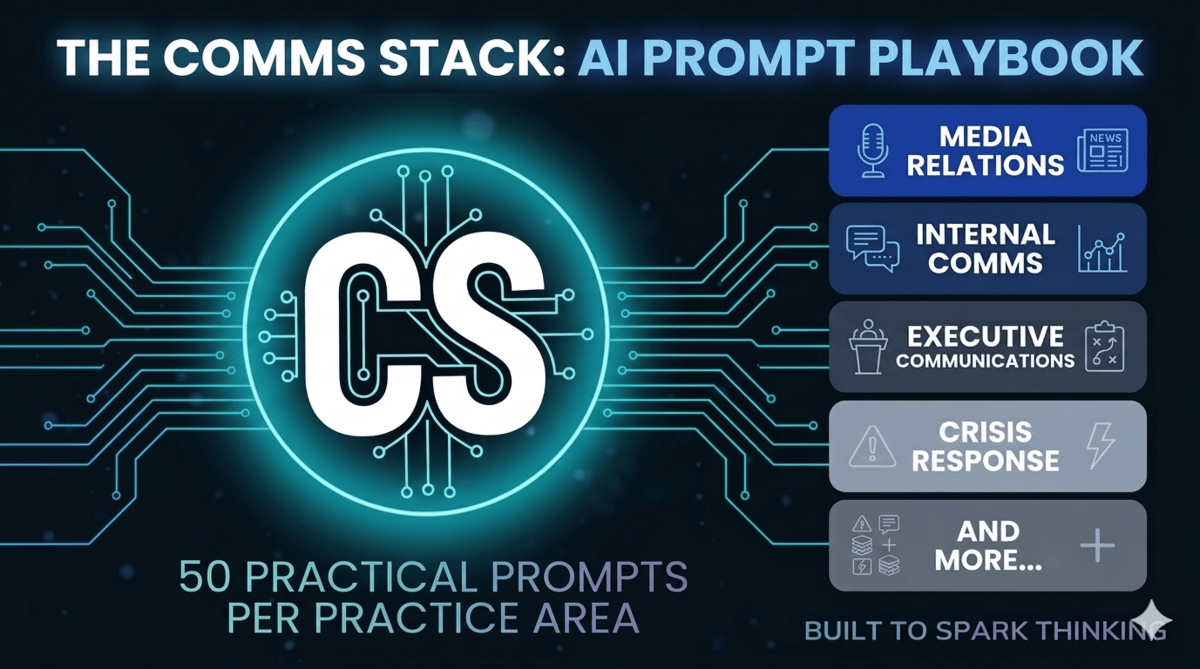
It’s a 50+ page Communications Prompt Playbook designed specifically for our field. This is the resource I wish I’d had when I started experimenting with AI in communications — something I could use as a reference to find a decent prompt to get me started for some of the most common situations we’re in, day to day.
You can download the full Communications Prompt Playbook below — for free:
🧭 Why I Made This
Most AI prompt resources fall into two camps: too generic to be useful, or too narrow to matter.
Communications work doesn’t fit neatly into “write me a blog post” prompts. We deal in nuance — risk, tone, credibility, cross-functional alignment, stakeholder interpretation, second-order effects. We need tools that reflect how we actually think. But, when we’re told to “use AI” (often without any further direction!), that level of complexity often creates blank page paralysis. I wanted to make it easier for us to hop onto Claude or Copilot or the like and get started.
This is the on-ramp I wish someone had made for me.
📚 What’s Inside
I can’t predict the future — if I could, I’d be buying lottery tickets, not writing this newsletter. But I tried to anticipate as many different needs as I could here. The playbook has more than a dozen communications disciplines in one place, each with 50 structured prompts. That’s 600+ prompts organized around the real questions we wrestle with: voice, audience, risk, measurement, credibility, governance, long-term narrative health. Whatever discipline you're working in, there's likely something here for you.
To be clear, these are designed to be thought starters, and only thought starters — if you pop one into an AI chatbot, it’ll put you on the path to something better, but it won’t fast-forward you to the finish line. They’re designed to help you pressure-test messaging, surface blind spots, generate angles, and build stronger first drafts — while keeping your judgment at the center. This is a starting point, not a shortcut to excellence.
🚨 Bonus: The Crisis Playbook
After putting this guide together, I had an idea for a bonus section — a cross-functional playbook specifically for crisis situations.
It maps prompts across more than a dozen communications functions at once — internal, external, exec, investor, etc. — so teams can coordinate under pressure. Each mini-section is role-specific and structured for real-world use. Most comms teams don’t actually have that documented anywhere. Now you do.
In fact, the crisis section alone is worth the 90 seconds it’ll take to download — it's the thing to open when your phone starts ringing and you need to coordinate three teams in the next hour.
👉 Your next step: Download the whole playbook here. And again, it’s free.
If you’re new to AI, this gives you a credible place to begin. If you’ve been experimenting but feel inconsistent, this gives you a sharper framework to build from.
🤝 And share it! If you find it useful, forward this email or share the download link with a colleague — sharing the page rather than the PDF means they'll always have the latest version. The more communicators who get comfortable using AI as a thinking tool — not a crutch — the stronger our work becomes.
SPONSORED BY
🖱 Another AI Newsletter
Become An AI Expert In Just 5 Minutes

If you’re a decision maker at your company, you need to be on the bleeding edge of, well, everything. But before you go signing up for seminars, conferences, lunch ‘n learns, and all that jazz, just know there’s a far better (and simpler) way: Subscribing to The Deep View.
This daily newsletter condenses everything you need to know about the latest and greatest AI developments into a 5-minute read. Squeeze it into your morning coffee break and before you know it, you’ll be an expert too.
Subscribe right here. It’s totally free, wildly informative, and trusted by 600,000+ readers at Google, Meta, Microsoft, and beyond.
SOMEONE ELSE PREDICTS THE FUTURE
🔮 Gartner Says: Comms is Becoming All About AI
A few weeks ago, Gartner released its “Top Communications Predictions for 2026: What Every CCO Must Know,” featuring an hour-long webinar that dives into the details. Don’t have an hour? No worries — they toplined it in the image, below.
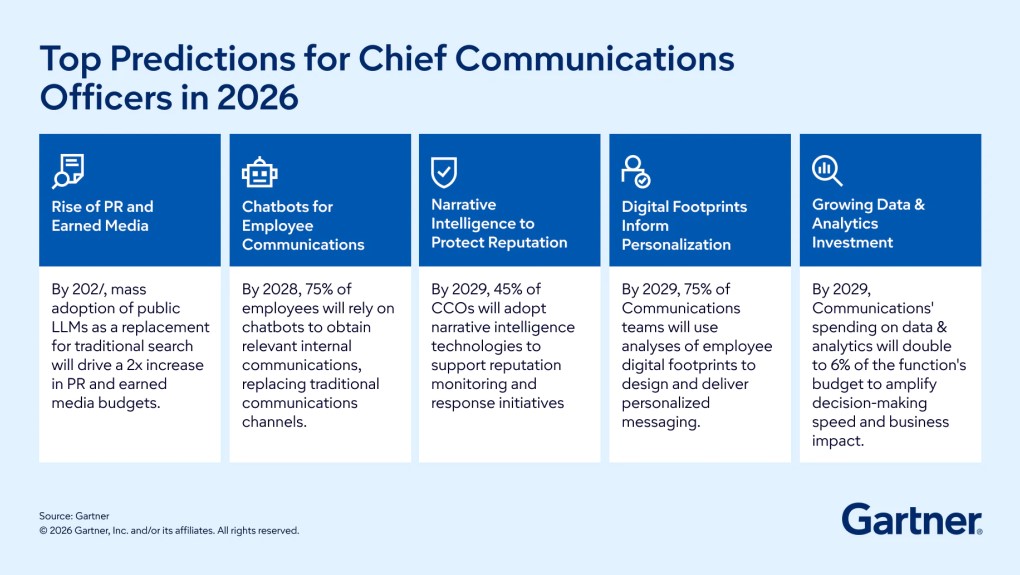
You can click the image for a larger (and more legible) version — or just read below 😀 And you’ll immediately see the key theme: AI is fundamentally changing how we work.
By 2027, mass adoption of public LLMs as a replacement for traditional search will drive a 2x increase in PR and earned media budgets.
By 2028, 75% of employees will rely on chatbots to obtain relevant internal communications, replacing traditional communications channels.
By 2029, 45% of CCOs will adopt narrative intelligence technologies to support reputation monitoring amid an intensifying disinformation landscape.
By 2029, 75% of Communications teams will use analyses of employee digital footprints to design and deliver personalized communications.
By 2029, Communications’ spending on data & analytics will double to 6% of the function’s budget to amplify decision-making speed and business impact.
Why it matters: If this is right — even if it’s just directionally correct — AI is going to become the intermediary between us, as storytellers, and our audiences. The LLMs are going to take our work, repackage it, and make it available in ways that we have to anticipate and master. And we’ll need a budget to help us do that.
Your next step: There’s a lot to do here, but I’d probably start with the narrative intelligence work. Map out your story — starting with your “why” — and how you want the world to understand it. Put that narrative in writing, stress-test it, and make sure leaders agree not just in principle, but in language.
Getting consensus and signoff on that story is a must-have before you communicate it internally or externally. In an AI-first world, repetition becomes reality: AI systems don’t invent narratives; they converge on the ones they see most often. If your framing is fuzzy, their synthesis will be, too.
THIS WEEK IN AI
🌎 Get Ready For Agent-Created Crises
A director at Meta, working on its AI safety and governance, lost a lot of her work when an AI agent deleted a bunch of emails it shouldn’t have. I saw a few comms pros flag this story with the same general take: AI agents are going to cause a lot of crises — and we need to be thinking, now, about how to communicate about their impact and our companies’ efforts to mitigate those problems.
I think they’re right. The Meta employee had guardrails in place, but those guardrails failed. It’s a flaw in the machine. Joshua Woodruff, a leader in security and agentic AI, explained the issue on LinkedIn:
Every AI agent has a working memory. Think of it like a whiteboard. Your instructions, your safety rules, your preferences, all written on that whiteboard in dry-erase marker. When the whiteboard fills up, the agent erases things to make room.
Your safety rules aren't in a locked frame on the wall. They're written right next to everything else. And they can get erased first.
This “whiteboard effect” is something OpenAI and other LLM leaders are aware of. Last summer, a spokesperson for OpenAI told Gizmodo that ChatGPT has built-in safeguards, and “these safeguards work best in common, short exchanges, [but] we’ve learned over time that they can sometimes become less reliable in long interactions where parts of the model’s safety training may degrade.”
How long is too long? That’s unclear, at best. And it’s not clear how fixable this is. So expect more crises like this in the future — and you may want to get your crisis plans in place now.
🎯 Quick Hits
How do image creation models see your brand? This LinkedIn post shares a Nano Banana prompt you can use to get Google Gemini to paint a picture of how your product appears in the context that consumers may see it.
Shared without comment: Accenture is tying promotions to AI use. OK, one comment: whether this is a good idea is a matter of taste, but I expect you’ll see more of this in the near future.
Claude made it easy to move your chat history from ChatGPT over to Claude itself. That means AI chatbots store that history somewhere. Inc. dove into who stores what, who can see it, and how you can manage it better.
SPONSORED BY
🖱 These ChatGPT Tricks Also Probably Work in Claude
Want to get the most out of ChatGPT?

ChatGPT is a superpower if you know how to use it correctly.
Discover how HubSpot's guide to AI can elevate both your productivity and creativity to get more things done.
Learn to automate tasks, enhance decision-making, and foster innovation with the power of AI.
ADD TO YOUR CALENDAR
📅 Vibe Code For Your Comms Team
Vibe coding — using platforms like Claude, Lovable, and Base44 — is getting a lot of attention, because it lets non-coders (like me!) to build apps that we would otherwise be unable to on our own. But it’s overwhelming — where do you start? what should you make? — and that may keep you from giving it a try.
Gab Ferree of Off The Record is addressing that this week with a free one-hour webinar. It’s a practical session — you’ll end up with a roadmap you can refine and ultimately act on.
🖖 Sign up here — there’s a session tonight, tomorrow, and Friday. (And tell Gab I say hi!)
COOL AI TOOLS
🔨 Five Tools To Try This Week
WorldTone AI - Culturally intelligent, people-first platform for planning, drafting, and scheduling global communications
PostSyncer - Cross-platform content scheduling and social distribution
JustReachOut - Identify and pitch reporters with this tool
Citable - Helps content get cited and referenced by AI systems
Knotch - AI-powered content intelligence that measures what content resonates with your audience
And don’t forget MESSAGE — My custom GPT that works with you to create a great first draft for just about any comm. (Learn more about MESSAGE here.)
Was this forwarded to you by a friend or colleague? Want to get this in your inbox next week? Click here to subscribe!
YOUR FEEDBACK WANTED
🔊 Help The Comms Stack Improve
What did you think of this week's email?
Until next Wednesday,
Dan